
5 Signs Your Laundry Needs a Renovation (Not Just a Tidy-Up)
Mould, slow drains, and a…
March 15, 2026
The laundry handles detergent, stain removers, cleaning chemicals, ironing supplies, dirty linen, pet-washing gear, and often the household vacuum and mop as well. Without a clear storage plan, all of this ends up piled on top of the washer, shoved under the sink, or stacked in precarious towers on the floor. In Perth, where hot summers drive more frequent washing and towel changes, a well-organised laundry saves genuine time every single day.
| Category | Key Takeaway |
|---|---|
| Space Maximisation | Utilise wall space above laundry appliances with overhead cabinetry to add up to 600L of storage without losing floor area. |
| Material Choice | Always specify MR MDF (Moisture Resistant) substrates for Perth laundries to prevent swelling and delamination. |
| Workflow | Integrate pull-out hampers and sorting systems early in the layout to streamline the transition from dirty to clean. |
| Safety & Hygiene | Effective storage keeps hazardous cleaning chemicals out of reach and ensures proper ventilation for appliances. |
Good storage solutions are not just about aesthetics. They keep hazardous chemicals out of reach of children, prevent clutter from blocking appliance ventilation ports, protect cleaning products from heat, and make sorting, folding, and ironing significantly faster.
Here are the most effective storage options for Perth laundries, with realistic costs and installation considerations.
| Storage Type | Typical Cost (installed) | Best For | Space Required |
|---|---|---|---|
| Overhead wall cabinets | $800 – $2,000 | Detergent, cleaning products, spare linen | Above washer/dryer or bench |
| Pull-out hamper baskets | $300 – $700 | Sorting whites, darks, colours | Inside base cabinetry (450 mm+ width) |
| Pull-out ironing board | $250 – $500 | Ironing without a standalone board | Inside tall or wall cabinet (min 300 mm depth) |
| Tall pantry-style cabinet | $1,200 – $2,500 | Brooms, mops, vacuum, bulk supplies | 600 mm x 600 mm floor footprint |
| Open shelving | $200 – $500 | Display jars, baskets, everyday items | Above bench or unused wall space |
| Under-bench drawers | $400 – $1,000 | Pegs, cloths, small cleaning tools | Below benchtop, beside sink |
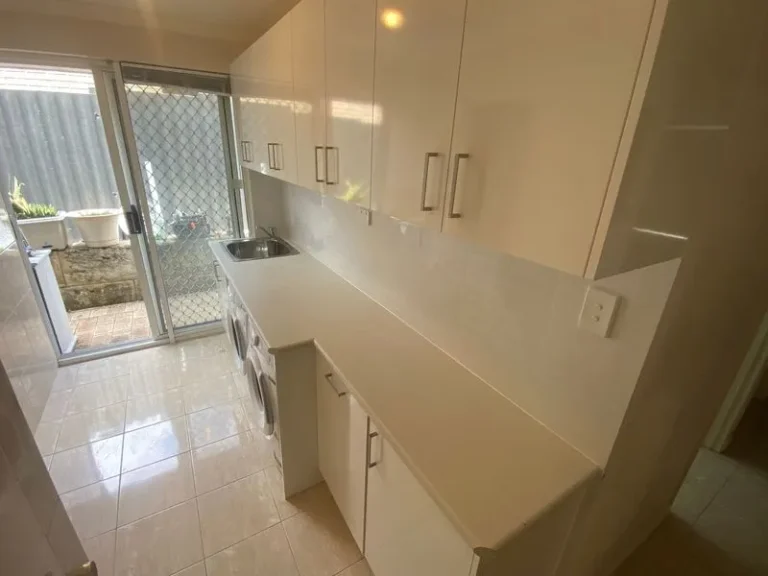
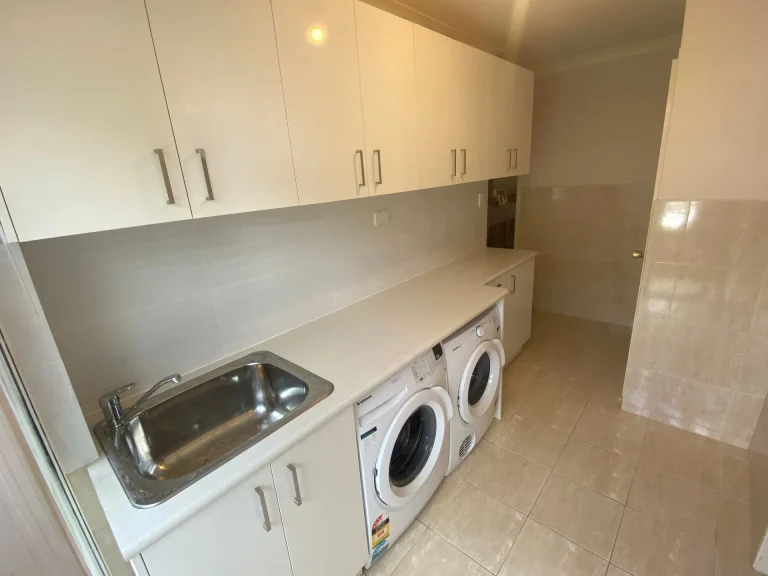
In most Perth laundries, the wall space above the washer and dryer sits completely empty. Installing overhead cabinets here gives you 300 to 600 litres of enclosed storage without taking up any floor area whatsoever. Use adjustable shelves inside so you can reconfigure them as your needs change over time, accommodating taller bottles on one shelf and stacked towels on another.
For moisture resistance in Perth’s sometimes humid laundry environment, choose cabinets with a polyurethane or two-pack painted finish rather than raw or paper-faced melamine. Moisture-resistant MDF (commonly labelled MR MDF by Australian suppliers) is the standard substrate for laundry cabinetry. Standard particleboard will swell and delaminate within a few years in a laundry environment, especially during winter when indoor drying increases humidity levels considerably.
Overhead cabinets must be securely fixed into wall studs or masonry, not just plasterboard. In older Perth brick homes across suburbs like Fremantle, Subiaco, and Nedlands, you will often be mounting into double-brick walls, which requires masonry anchors rated for the cabinet weight when fully loaded. In newer timber-framed homes common in Wanneroo and Joondalup, your installer must locate the studs and use appropriate coach screws. Verify the wall type and fixing method before committing to a cabinet layout. This structural integrity is vital when planning laundry cabinet replacement projects.
A two- or three-compartment pull-out hamper system, mounted on full-extension drawer runners, lets every family member sort laundry as they go rather than dumping everything into one pile. The baskets sit inside a base cabinet and slide out smoothly for loading and unloading. Fabric hamper bags are removable, so you can carry them directly to the washing machine without transferring clothes. For families in larger Perth homes, this single upgrade transforms the laundry workflow.
For delicates that cannot go in the dryer, a pull-out drying rack mounted inside a cabinet or under the benchtop provides a discreet indoor drying space. This is particularly useful in apartments and townhouses where outdoor drying space is limited or non-existent. The rack slides back into the cabinet when not in use, keeping the laundry looking tidy.
A fold-down ironing board built into a wall cabinet or drawer eliminates the need for a freestanding board that takes up closet space elsewhere in the house. These boards are typically 900 mm to 1,000 mm long, which is adequate for most garments. They mount at a fixed height, so choose a position that is ergonomically comfortable for the primary user.
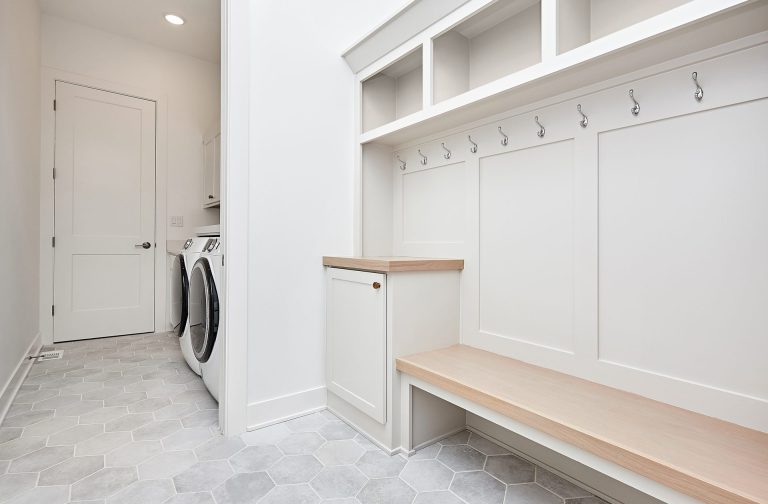
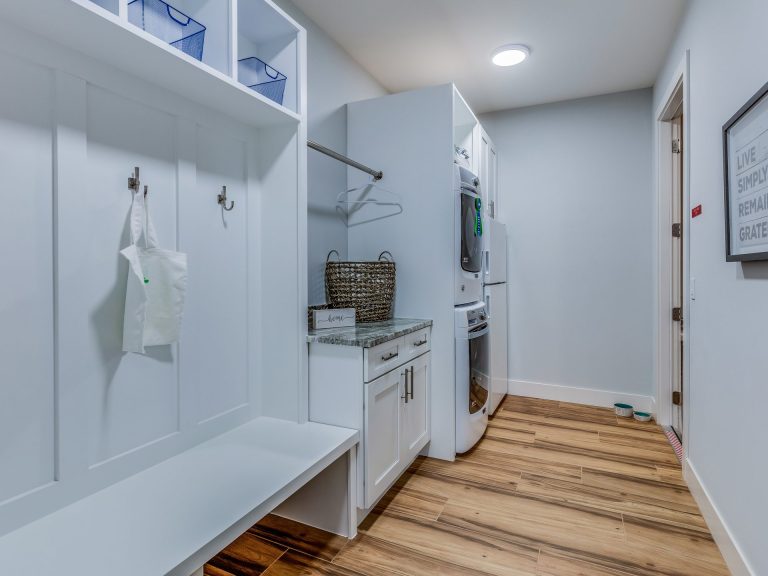
If your laundry is a compact cupboard or galley space, vertical storage is essential. Stack your washer and dryer to free up floor area. Use every centimetre of wall height with floor-to-ceiling cabinetry. Magnetic strips on the inside of cabinet doors can hold small metal items like scissors, lint rollers, and bottle openers. Over-the-door hooks and hanging organisers add storage to the back of the laundry door itself.
For more ideas on maximising tight spaces, see our guide to small laundry redesigns tailored for Perth homes.
The most functional laundries follow a logical workflow: dirty laundry enters the room, gets sorted by colour or fabric type, washed, dried, folded on the bench, and placed into storage or carried to bedrooms. Arrange your storage to match this sequence. Hamper pull-outs near the entry point, washer and dryer in the middle, and a folding bench with overhead storage at the far end. When the layout supports the workflow, the room works effortlessly and becomes a natural part of your complete laundry renovation.

Tell us what you’re working on. Free site visit, indicative budget, no obligation.
Get a Fast Quote